
The Accidental Operating System
For years, people criticised Holacracy as too rigid — obsessed with explicitly defined roles, constitutional governance, distributed authority, and transparent accountability. Too much structure for messy, human organisations.
It turns out that rigidity is exactly what AI agents need.
The structure nobody wanted
I spent a decade at Amazon, where structure was the air you breathed. Every team had a clear mandate. Every service had an owner. Every decision had a mechanism. It felt constraining at times, but it worked — at extraordinary scale.
When I moved into smaller organisations, I found the opposite. Roles were fluid, which sounded liberating but usually meant nobody quite knew who owned what. Decisions happened in corridors, or didn't happen at all. Knowledge lived in people's heads and walked out the door when they left. This is what I'd later describe as Mountain One — things work, but only because specific people make them work.
Holacracy tried to fix this. It took the kind of explicit structure that large organisations develop over decades and packaged it as a system anyone could adopt. It replaced job titles with defined roles, management by charisma with constitutional governance, and delegation that could be revoked on a whim with distributed authority.
The problem was that humans didn't particularly enjoy it. We like ambiguity. We like the informal. We like being able to say "that's not really my job" while simultaneously doing someone else's job because we're good at it. Holacracy demanded a level of explicitness that felt bureaucratic and cold to most teams that tried it.
What agents actually need
AI agents don't thrive in traditional hierarchies. They need clear boundaries, decision protocols, autonomy and accountability, and Holacracy supplies each in turn: explicit roles, constitutional governance, distributed authority and transparent ownership.
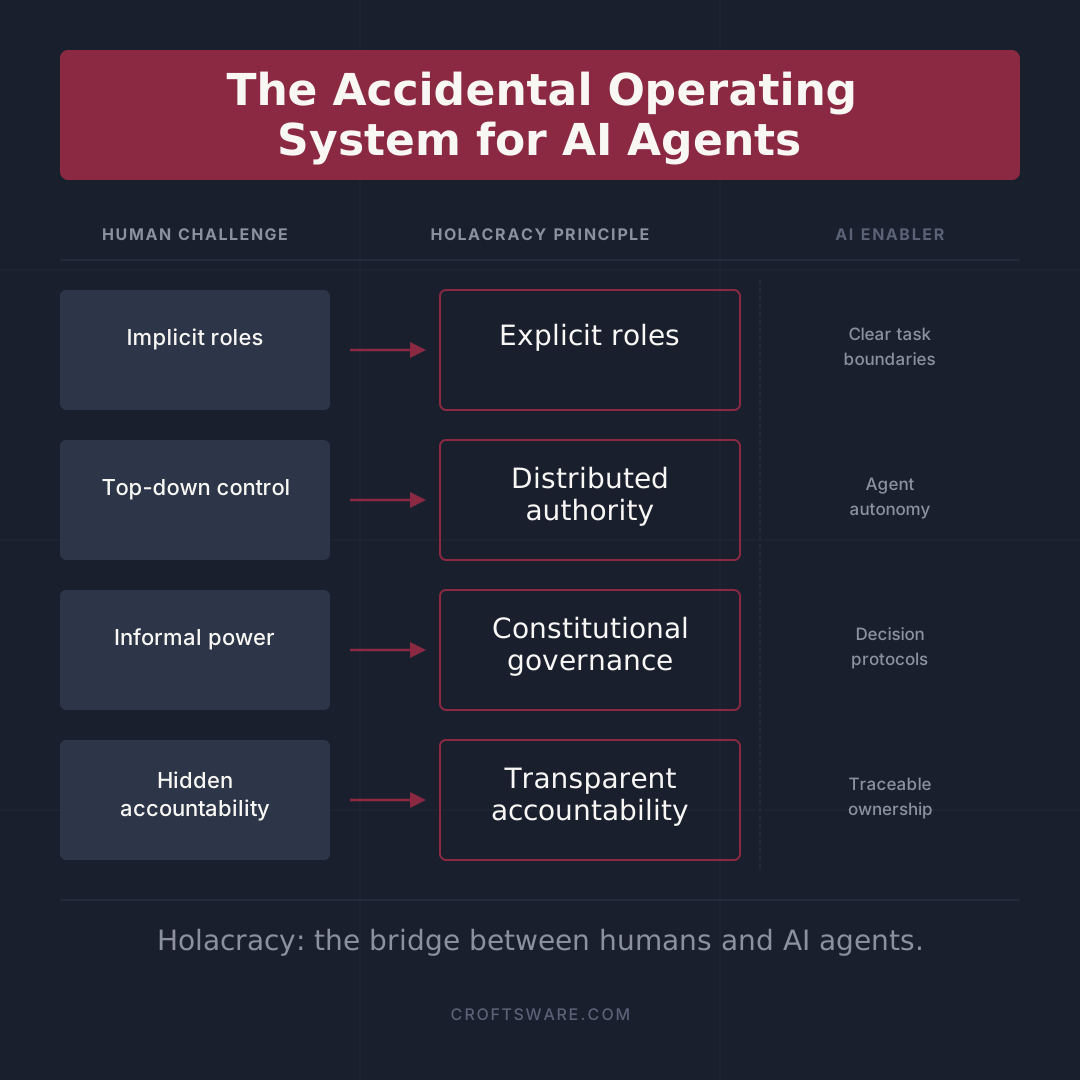
Every frustration humans had with Holacracy maps directly to something an AI agent requires. The rigid role definitions that felt dehumanising tell an agent exactly what it's responsible for. The constitutional governance that felt like bureaucracy gives it explicit decision protocols, without which it will hallucinate its own. The transparent accountability that felt like surveillance tells it who to report to and what to escalate.
Accidental architecture — a system designed for one purpose that turns out to be the foundation for something entirely different.
The operating system analogy
Holacracy was designed to make human coordination explicit, and in doing so it created the kind of structure AI agents need to collaborate. It's like designing an operating system for a computer that didn't exist yet.
An operating system manages resources, enforces boundaries, handles permissions, and coordinates processes. That's exactly what Holacracy does for an organisation. The fact that humans found it too rigid is precisely what makes it suitable for agents, which need rigidity to function reliably.
This doesn't mean every organisation should adopt Holacracy. But it does mean that an AI strategy matters less than whether an organisation already knows how to operate with clarity, explicit processes, and distributed decision-making. The organisations succeeding with AI are the ones that have climbed from Mountain One to Mountain Two.
Twenty years early
Holacracy might have been twenty years early. The organisations that dismissed it as too structured may find themselves scrambling to build exactly that structure when they try to deploy agents at scale. And the few that persisted with it may discover they've been running the right operating system all along.